

The Five Most Important Structures at Monte Albán and Why They Matter
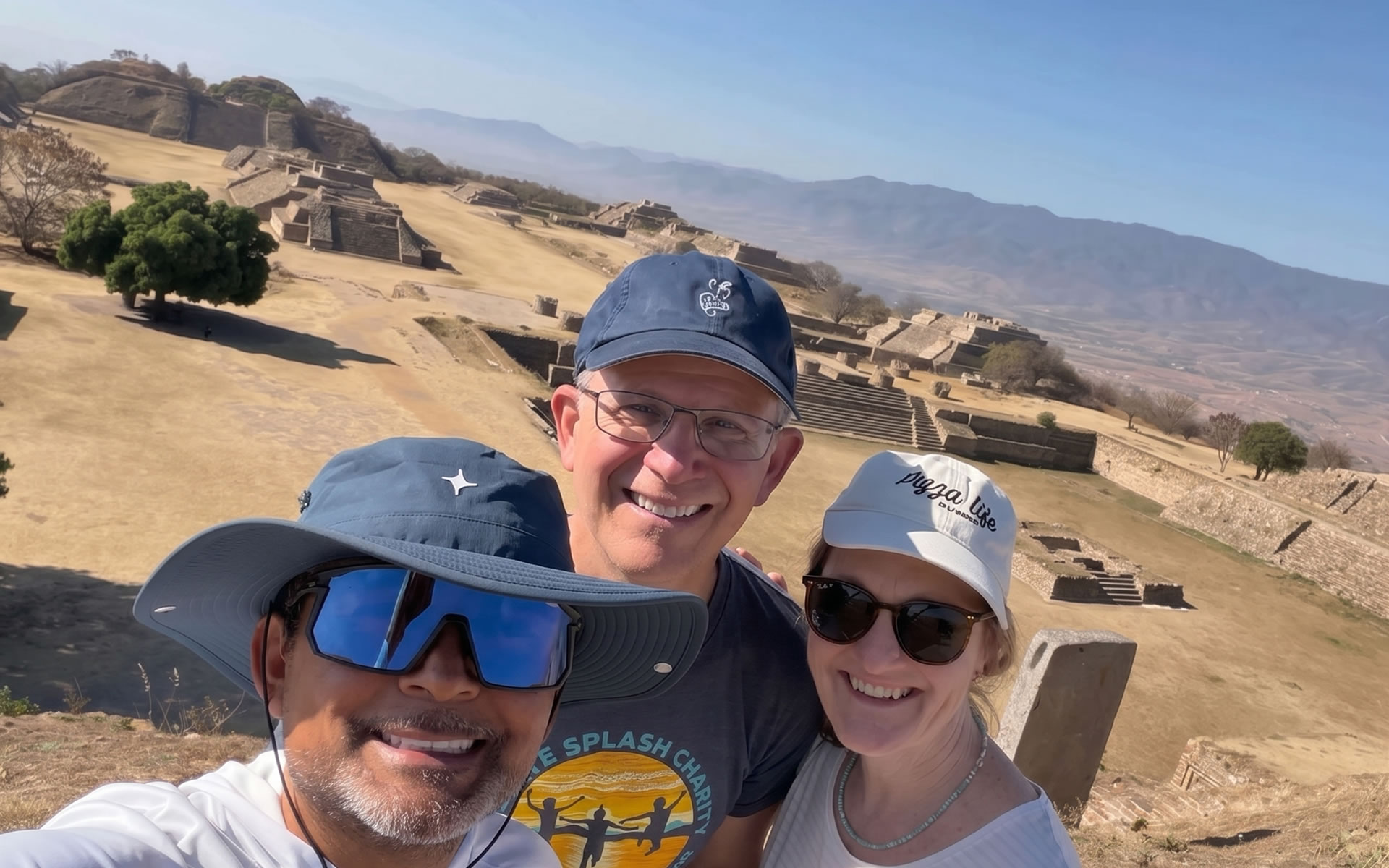
1. The Main Plaza – The Ceremonial Heart of the City
The vast rectangular plaza at the center of Monte Albán is the most striking feature you see upon arrival. Measuring roughly 300 by 200 meters, it was the main public and ceremonial space where thousands of people gathered for rituals, markets, and important events. During its Phase II (200 BC – 250 AD), the top of the mountain was transformed into the Great Plaza, the ceremonial center surrounded by two-room temples. Among them, Building J stands out for its unusual arrowhead-shaped floor plan. This structure is not only an architectural icon, but an astronomical observatory that, according to expert Anthony F. Aveni, is aligned with the star Capella, reflecting the advanced knowledge of the cosmos that the Zapotecs possessed.
Its careful north-south alignment and the way the surrounding buildings frame the sky and the valley below demonstrate the advanced urban planning of the Zapotec people.
This open area connected the different parts of the city and served as the stage for political and religious life. Standing here, you can feel the scale and ambition of Monte Albán as one of the earliest planned cities in the Americas.
2. Building J – The Famous Observatory
One of the most unique structures at Monte Albán is Building J, often called the Observatory. Unlike the other rectangular buildings aligned with the plaza, this one has an arrow-like shape and is deliberately rotated at an angle. Scholars believe it was used for astronomical observations, possibly to track the movements of stars or the planet Venus, which held great importance in Zapotec cosmology.
More than an observatory, Building J is a testimony to Zapotec dominance. Its walls feature 40 carved slabs, known as “conquest stelae”, that record military victories over regions that we now know as Cuicatlán, Miahuatlán and Tututepec. Visiting this unique structure is to understand how Monte Albán integrated the science of the stars with the political control of the entire Oaxacan territory.
Its unusual orientation and the carvings found nearby show the deep knowledge of astronomy and mathematics that the ancient Zapotecs possessed more than 2,000 years ago.
3. The Ball Court – A Window into Ancient Ritual and Sport
Monte Albán has one of the earliest known ball courts in Mesoamerica. The game played here had different meanings and could have been played for many reasons. From neighborhood sport to court ritual. Many Mesoamerican cultures saw in the ball game a metaphor for the movements of celestial bodies, particularly the sun, the moon or Venus. The game was not only a sport but a sacred ritual that symbolized the struggle between opposing forces, often linked to fertility, the sun, and the underworld. The court is relatively small compared to later Maya examples, but its presence shows how central this tradition was to Zapotec society from very early times.
In the era of the Spanish conquest, both fans and professionals participated in the game, and often the competition was accompanied by large bets.
Walking beside it helps you imagine the crowds that once gathered to watch or participate in these important ceremonies.
4. The Danzantes Gallery – Early Writing and Powerful Imagery
On the west side of the Main Plaza you will find the famous Danzantes stones — large carved slabs showing human figures in dynamic poses. For a long time they were thought to represent dancers, but most scholars now believe they depict captives or defeated enemies, with glyphs that are among the earliest examples of writing in Mesoamerica.
These carvings are extremely important because they show political power, warfare, and the beginning of a written language in the Oaxaca region long before other major civilizations developed similar systems.
5. The North Platform – Elite Residences and Administrative Center
The massive North Platform rises at one end of the plaza and once housed the city’s ruling elite. It contains palaces, tombs, and administrative buildings where the highest-ranking families lived and governed. From the top you have one of the best panoramic views over the entire site and the Oaxaca Valley below.
Its size and location reflect the social hierarchy of Monte Albán and give visitors a clear sense of how power was organized in this ancient capital.
Visitor Information
Monte Albán is open daily from 8:00 am to 5:00 pm. The entry fee is 210 MXN per person and tickets can be purchased at the site. The best time to visit is early morning when the light is beautiful, the temperature is cooler, and there are fewer visitors. Comfortable walking shoes are essential because the site has uneven stone paths and some gentle slopes. Bring water, sunscreen, and a hat, as the mountaintop can be sunny and exposed.
Most visitors spend two to three hours exploring the main structures. Guided tours are available and highly recommended if you want deeper historical context. The site is easily reached by taxi, colectivo, or private transfer from Oaxaca City, and many people combine a visit to Monte Albán with a stop at one of the Sierra Norte villages for a full day of culture and nature.
Whether you are interested in architecture, astronomy, or the daily life of an ancient civilization, these five highlighted points give you a strong understanding of why Monte Albán remains one of Mexico’s most impressive archaeological treasures.
References
- Monte Albán Official Site and UNESCO World Heritage Information — whc.unesco.org
- Archaeological descriptions from INAH — inah.gob.mx
- Visitor guides and practical information — oaxaca.travel
- The gods and symbols of ancient Mexico and the Maya by Miller/Taube
- El pasado indígena by Alfredo López Austin and Leonardo López Luján