

Oaxaca Carnaval 2026: Best Towns to Visit for Devils, Masks, Music, and Tiliches
What Oaxaca Carnaval is, and when the 2026 peak happens
Oaxaca’s cultural geography is shaped by Indigenous continuity and centuries of adaptation under colonial rule. Carnaval, the days leading into Lent, is one of the clearest moments when that history becomes visible in public space. You will see masks, music, and playful disorder, but you will also see how communities reinforce identity, memory, and belonging through performance.
In 2026, Shrove Tuesday falls on February 17 and Ash Wednesday falls on February 18, so many towns concentrate their biggest celebrations on the weekend before Ash Wednesday and on the Tuesday itself. Exact schedules are always local and can shift, which is why Oaxaca Carnaval is best approached as a region of village celebrations rather than a single city event.
Why the “real” Carnaval is often outside the city center
Travelers sometimes expect a single, city-wide parade, but Oaxaca’s most distinctive Carnavales are decentralized. In the Central Valleys and in parts of the Mixteca, town celebrations can feel like a public conversation where everyone participates: families, musicians, artisans, teenagers testing costumes, and elders who remember how things were done a generation ago.
Three places that are frequently discussed by visitors are San Martín Tilcajete, Villa de Zaachila, and Putla Villa de Guerrero. Each offers a different lens on Carnaval, from the intensity of “oiled devils,” to stilt dancing traditions, to the bright, rag-layered identity of the tiliches.
Masks and satire: how social tension becomes a shared ritual
Masks matter in Oaxaca because they transform the wearer into a character who can speak more freely. That freedom often takes the form of satire: mock authority, exaggerated manners, playful fear, and public teasing that would feel inappropriate on an ordinary day. In many communities, Carnaval is one of the few times when role reversal is not just tolerated but expected.
In San Martín Tilcajete, reporting on the town’s Carnaval notes that dancers use monstrous masks to scare and thrill neighbors and to evoke protector animals that are understood locally as a form of spiritual defense. This does not make the celebration “anti-religious.” For many participants, the intensity of the Tuesday celebration sits beside the reality that Lent begins the very next day.
San Martín Tilcajete: the aceitados, sound, and close contact
San Martín Tilcajete is widely associated with woodcarving, and during Carnaval that visual creativity shows up in masks and character design. The best-known figures are the aceitados, often described as “oiled devils.” They move through the streets in groups, wearing large masks and loud cowbells that turn walking into percussion. The experience is physical: the crowd shifts, bands play, bells clank, and the street becomes a shared stage.
Visitors should know one simple rule: this is a high-contact celebration. If you stand close to the flow, you may be smeared with oil or pigment as a sign that you are included in the joke. If you prefer distance, watch from the edges, protect your camera, and avoid wearing anything you cannot permanently stain.
- What to wear: older clothes and shoes that can handle permanent marks.
- Skin protection: a thick layer of sunscreen can make cleaning easier afterward.
- Phone and camera safety: use a protective case or a simple plastic cover in dense crowds.
Villa de Zaachila: zancudos and community promise
Zaachila is close to Oaxaca City, which makes it a practical choice for travelers who want a village Carnaval without a long transfer. The town is known for the Danza de los Zancudos, performed on stilts, and described in local cultural coverage as a tradition linked to a promise made to San Pedro. The result is both athletic and ceremonial: balance, endurance, and a public display of collective effort.
For a visitor, the best way to appreciate the zancudos is to watch how the crowd responds. This is not only a “show.” It is also a marker of local pride, rehearsal, and shared responsibility. A smile, patience in tight streets, and basic courtesy toward performers go a long way.
Putla Villa de Guerrero: tiliches and the pride of reuse
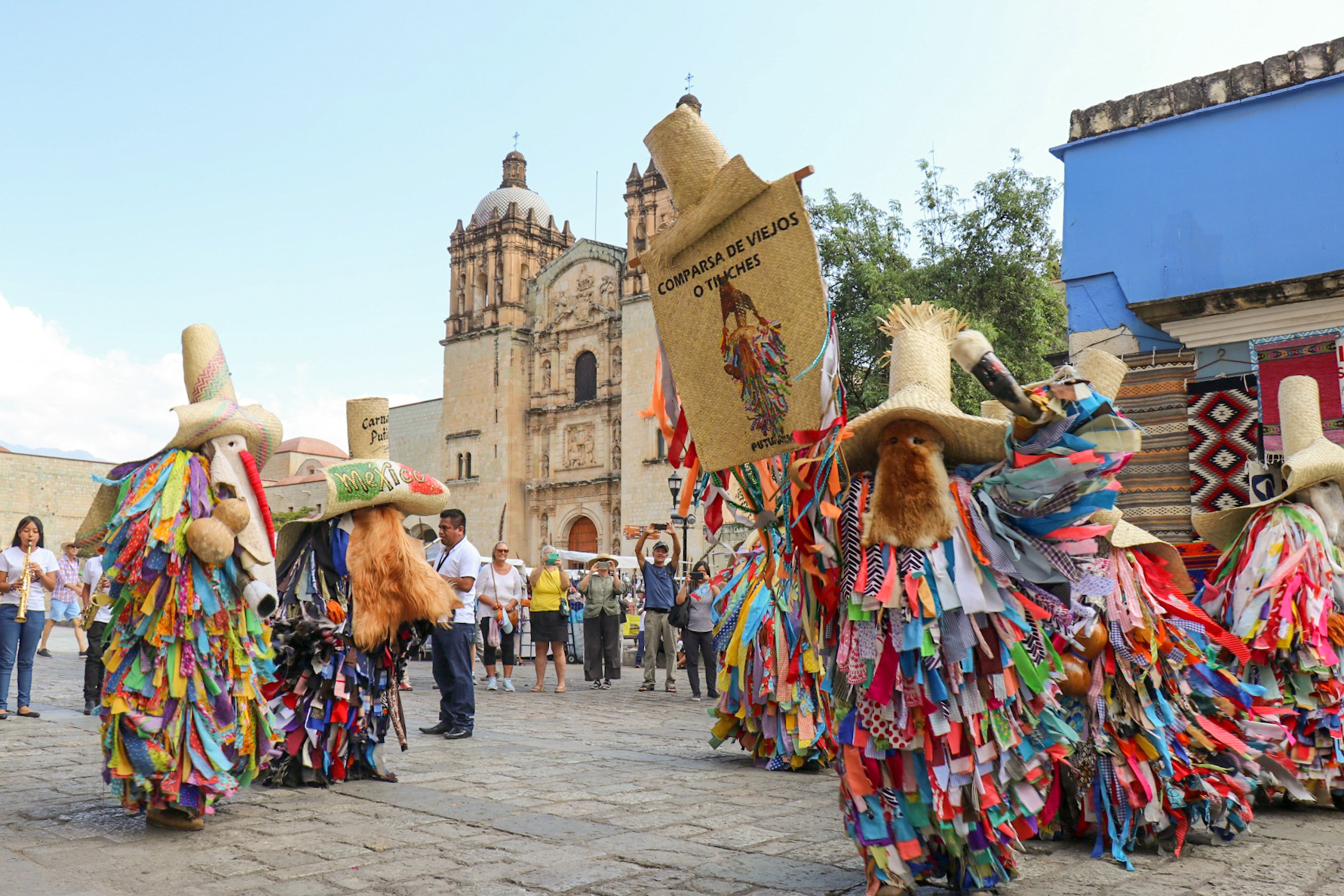
Putla Villa de Guerrero, in the Mixteca region, is famous for its Carnaval energy and for the tiliches, dancers in layered costumes built from scraps and bright materials. A local Oaxaca food and mezcal venue describes the tiliches as appearing in Putla during Carnaval on the weekend prior to Ash Wednesday, which aligns with how many travelers experience the celebration: several days of activity rather than a single afternoon.
The tiliche costume is more than decoration. It is social commentary built from everyday materials, turning “making do” into beauty and movement. If you attend, look for the balance between improvisation and tradition: each costume is personal, but the silhouette and the attitude remain recognizable.
- Classic tiliche: rag-layered clothing that creates volume and movement while dancing.
- Modern variations: some groups experiment with mixed materials for texture and sound while keeping the traditional outline.
- What it expresses: resilience, humor, and a public celebration of local identity.
Food and drink: guelaguetza as sharing
Food is a quiet center of Carnaval. In many towns, the plaza becomes a place where families share what they have, and visitors often experience a form of practical hospitality: a taste offered, a cup handed over, a seat made available. This spirit is closely aligned with Oaxaca’s broader tradition of communal reciprocity, often described locally as guelaguetza, or mutual giving.
You might encounter mole dishes in many forms, alongside stews, tamales, and regional snacks. Two drinks that are especially associated with Oaxaca are tejate, a cold maize and cacao beverage documented as a traditional drink of the region, and tepache, a lightly fermented pineapple drink commonly made with piloncillo and cinnamon in many parts of Mexico. Mezcal often appears as a gesture of welcome, offered in small sips rather than as a formal tasting.
Practical logistics from Oaxaca City
Many travelers base themselves in Oaxaca City and visit surrounding towns for day trips. For Putla, most people plan an overnight because the distance is significant and the road can be slow. Rome2rio publishes current distance and travel time estimates that are useful for rough planning, especially if you are comparing bus and private transport.
- Oaxaca to San Martín Tilcajete: road distance about 26 km.
- Oaxaca to Villa de Zaachila: short trip, commonly under 20 minutes by taxi in typical conditions.
- Oaxaca to Putla Villa de Guerrero: about 250 km, with direct bus options reported once daily and travel times around four hours in typical conditions.
If you want help coordinating village visits, timing, and respectful participation, you can use the reservations page or send an inquiry through the contact form.